This article describes how ELSA shows IPA across the app, including the latest student experience.
ELSA is committed to providing accurate and professional IPA transcriptions. However, different dictionaries often have different editorial preferences. We aim to keep our transcriptions as simple and accessible as possible while staying aligned with major reference standards.
Below are the five primary areas where these differences usually occur:
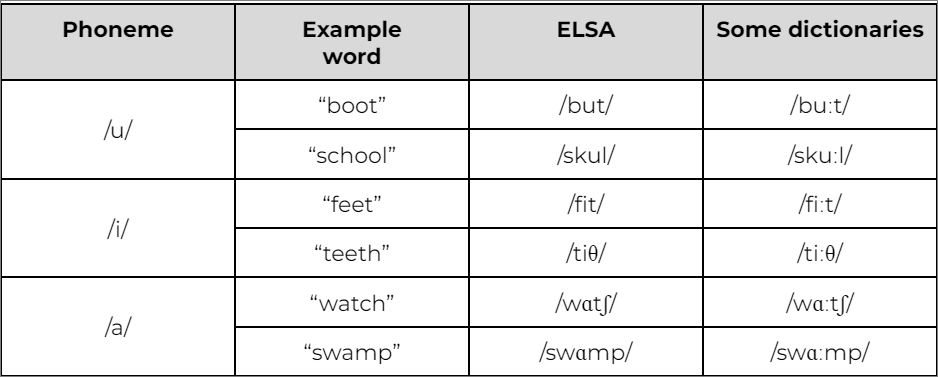
1. Predictable Vowel Length
In English, vowel length (duration) is often predictable based on the sound itself.
Example: The sound /i/ is always long, while /ɪ/ is always short.
ELSA’s Approach: Some dictionaries use the symbol /ː/ to represent length. For simplicity and to avoid clutter, ELSA does not use the length symbol.
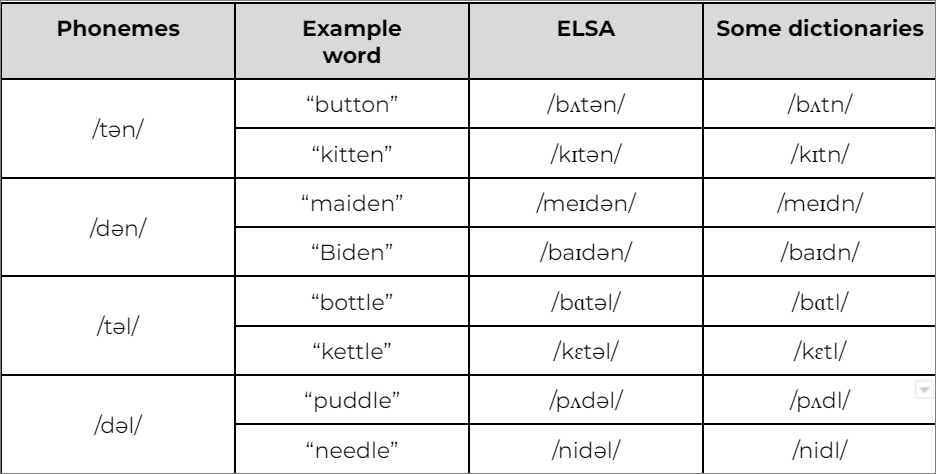
2. Predictable Variants (The Schwa)
The Schwa /ə/ can often be dropped in certain contexts depending on the speaker's speed or style.
ELSA’s Approach: While some dictionaries omit the schwa in these instances, ELSA includes the schwa in the transcription but always accepts both versions (with or without the sound) as correct.
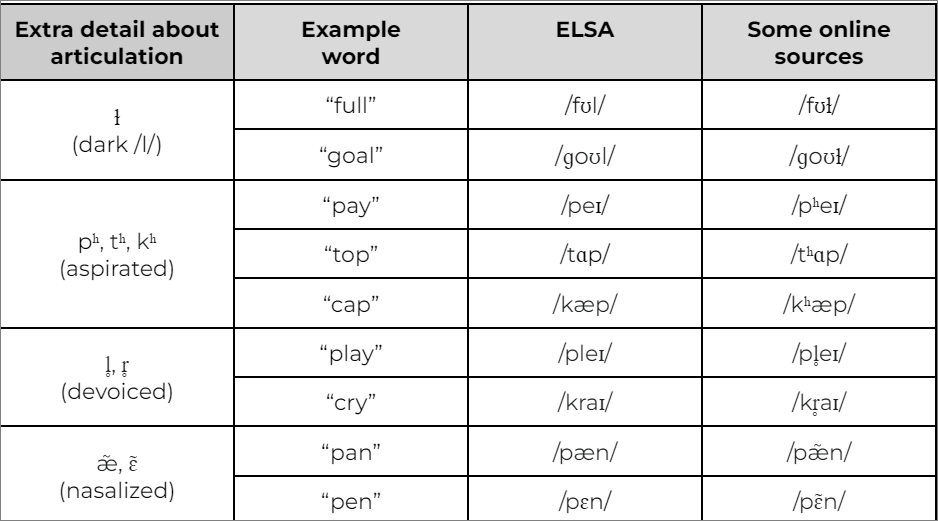
3. Narrow Transcription
Linguists and speech pathologists often use "narrow transcription," which includes extra symbols (diacritics) to show exactly how a sound is articulated.
ELSA’s Approach: Most standard dictionaries avoid these extra marks to keep things readable for learners. ELSA follows this standard dictionary approach and does not use narrow transcription symbols.
4. The Case of "R"
The technical IPA symbol for the English "R" sound is /ɹ/.
ELSA’s Approach: Because the regular letter "r" is much more convenient and widely recognized by students, ELSA (and most major dictionaries) uses /r/ instead of /ɹ/.

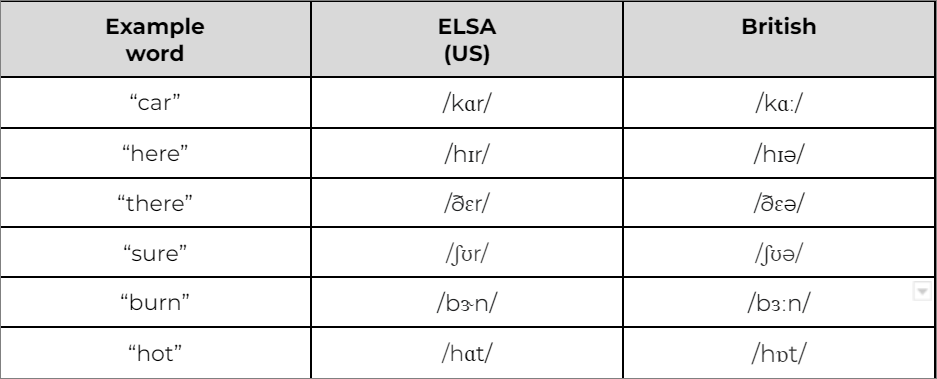
5. US English vs. Non-US English
ELSA focuses on US English pronunciations.
British English Indicators: If you see a schwa used to represent the "R" at the end of a word, or the symbol /ɒ/ in a word like "hot," you are likely looking at a British English dictionary.
ELSA’s Approach: ELSA currently does not support these British English symbols, focusing exclusively on American English phonetic standards.
Was this article helpful?
That’s Great!
Thank you for your feedback
Sorry! We couldn't be helpful
Thank you for your feedback
Feedback sent
We appreciate your effort and will try to fix the article