Every assignment has a score. How that score is calculated depends on what your teacher included—one activity type or several lessons mixed together. Below you’ll see how assignment scores work, then how to read detailed feedback for Study Sets, Read Alouds, and AI Roleplays.
What can be in one assignment?
Your teacher can group multiple Read Aloud lessons into a single Read Aloud assignment and change the order of lessons.
Your teacher can group multiple AI Roleplay lessons into a single AI Roleplay assignment and change the order of lessons.
Your teacher can mix Study Set, Read Aloud, and AI Roleplay in one assignment. They can combine content from My Content and ELSA Content when building the assignment.
How your assignment score is calculated
Each lesson earns a score when you complete it. The assignment score summarizes those lessons as follows:
| Type of assignment | Assignment score |
|---|---|
| Study Set only | The average of your scores across all Study Set lessons in that assignment (same overall idea as before: your performance across every part). |
| Read Aloud only | (RA1 + RA2 + … + RAn) ÷ n — the average of your scores for each Read Aloud lesson, where n is the number of Read Aloud lessons. |
| AI Roleplay only | (RP1 + RP2 + … + RPn) ÷ n — the average of your scores for each roleplay lesson, where n is the number of roleplay lessons. |
| Mixed (Study Set + Read Aloud + AI Roleplay) | (Sum of every lesson’s score) ÷ (total number of lessons) — one average across all lessons, no matter the activity type. |
Study Set: detailed feedback
In a Study Set lesson, you practice one word or phrase at a time. Your score reflects your accuracy on each item. When an assignment has several Study Set lessons, the assignment score is the average across those lessons, as in the table above.
Individual Scores: You get an instant score (from 0% to 100%) for every word you practice.
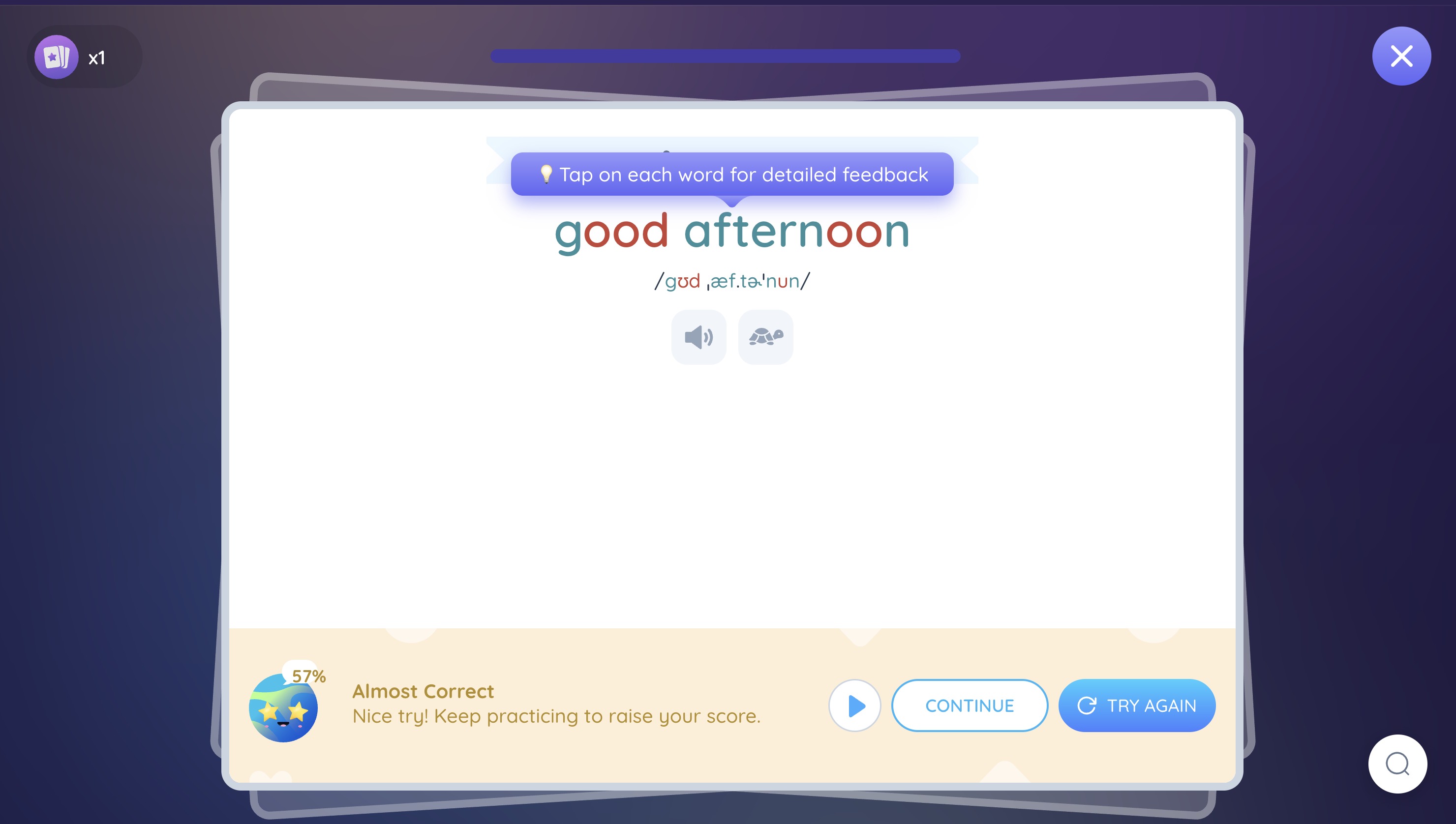
- Meaning of the Colors
- Our technology measures the nativeness of your English ability on a scale of 0~100%. We color code them based on the score:
- Red: 0-39%
- Yellow: 40-79%
- Green: 80-100%
- Our technology measures the nativeness of your English ability on a scale of 0~100%. We color code them based on the score:
- Meaning of the Colors
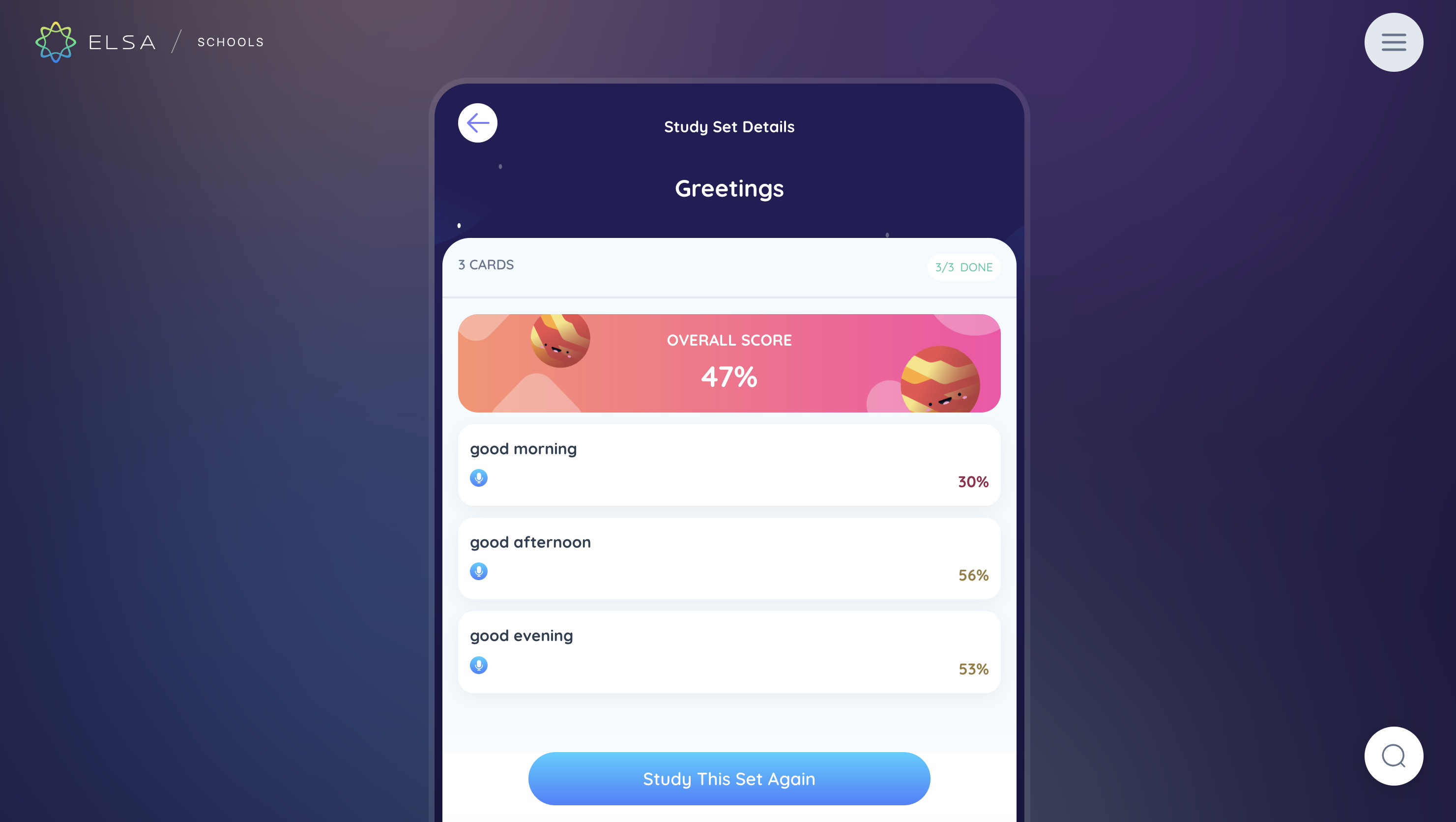
Overall Score (lesson): When you finish a lesson, you will see an Overall Score for that lesson. This is the latest average of all the individual scores from that lesson, giving you a clear idea of how you did on the set as a whole.
Read Aloud: detailed feedback
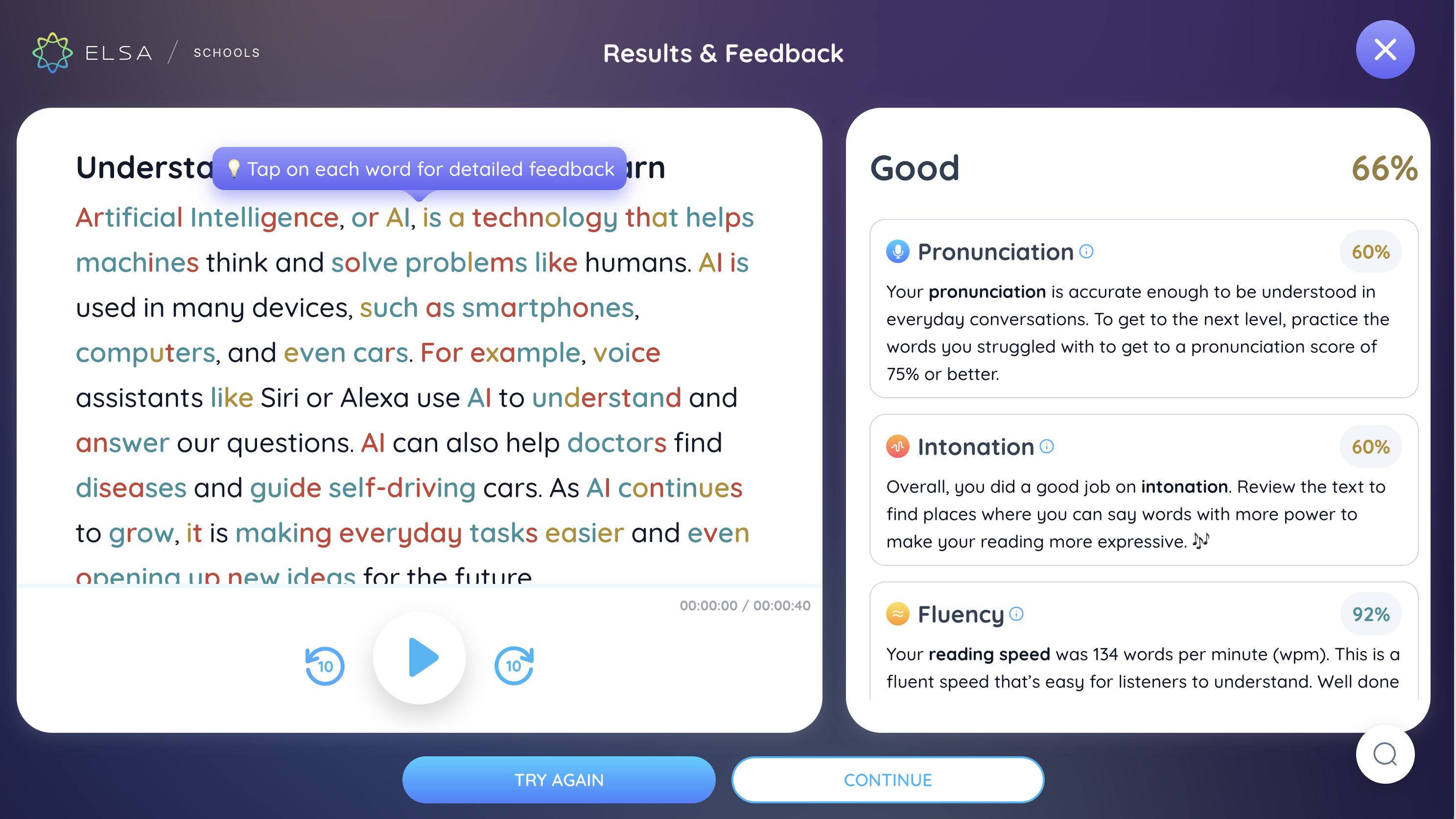
For each Read Aloud lesson, you receive a score for that lesson. It is calculated from your pronunciation, intonation, and fluency on that read aloud. When there are several Read Aloud lessons in one assignment, the assignment score averages those lesson scores (see table above).
Lesson score: You receive a score that assesses your overall reading performance for that lesson. This is your latest score for that lesson.
Error Highlighting: After you finish, the text will be displayed again, with any mispronounced words highlighted.
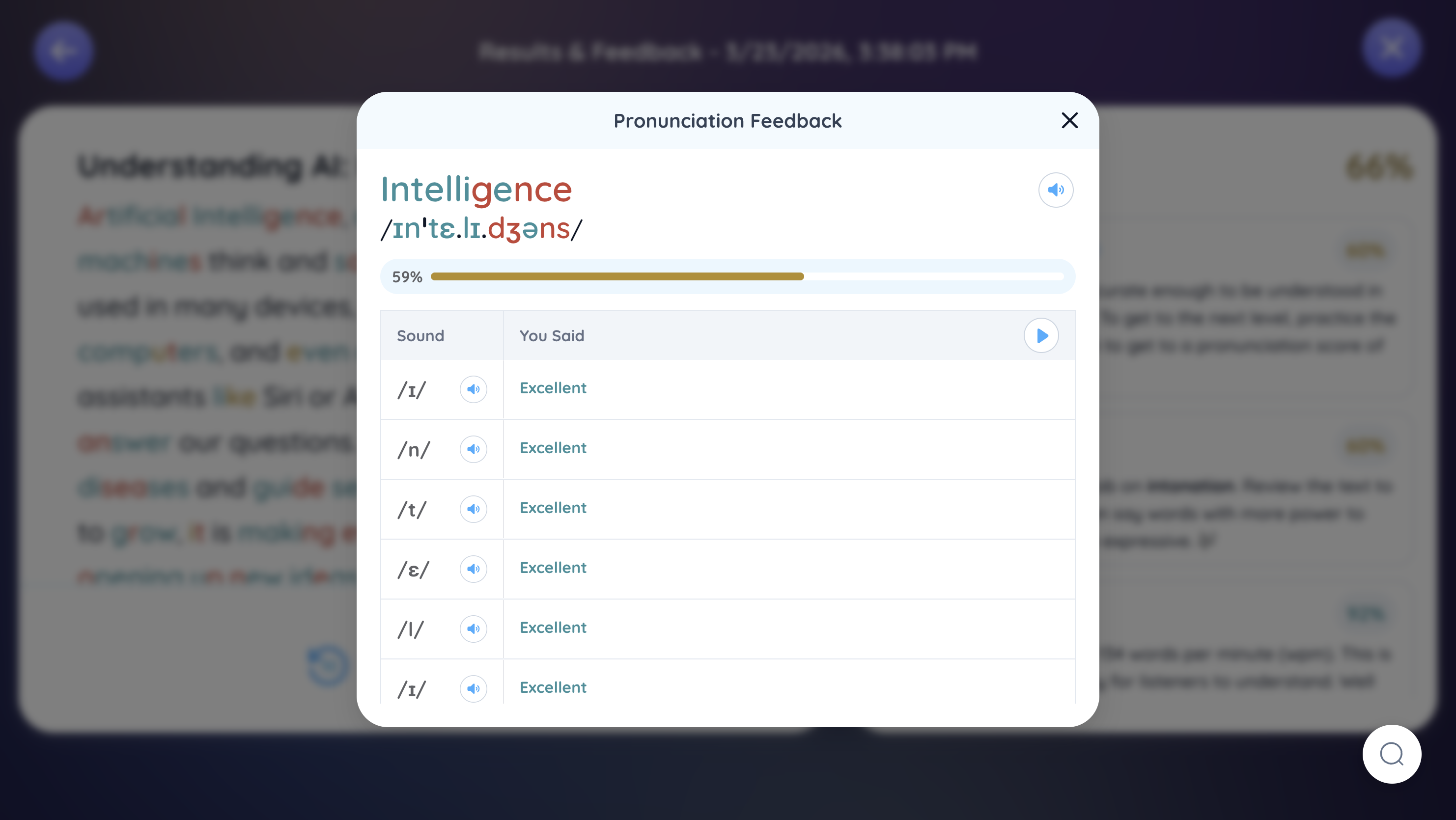
Detailed Feedback: You can tap on any highlighted word to see a detailed, sound-by-sound breakdown of your pronunciation, just like in a Study Set.
AI Roleplay: detailed feedback
For each AI Roleplay lesson, you receive an overall score for that lesson. It is calculated from your pronunciation, intonation, fluency, and grammar in that roleplay. When there are several roleplay lessons in one assignment, the assignment score averages those lesson scores (see table above).
- Grammar and vocabulary (roleplays): You need at least 50 words spoken for a grammar analysis, and at least 75 words for a vocabulary analysis. If you speak fewer than that, the app shows N/A for that area.
- Goals and feedback: You may also see whether conversation goals were met and written tips from ELSA.
How it may look: In some cases, your teacher can choose for results to show stars instead of (or in addition to) the usual score presentation—follow what you see on your results screen.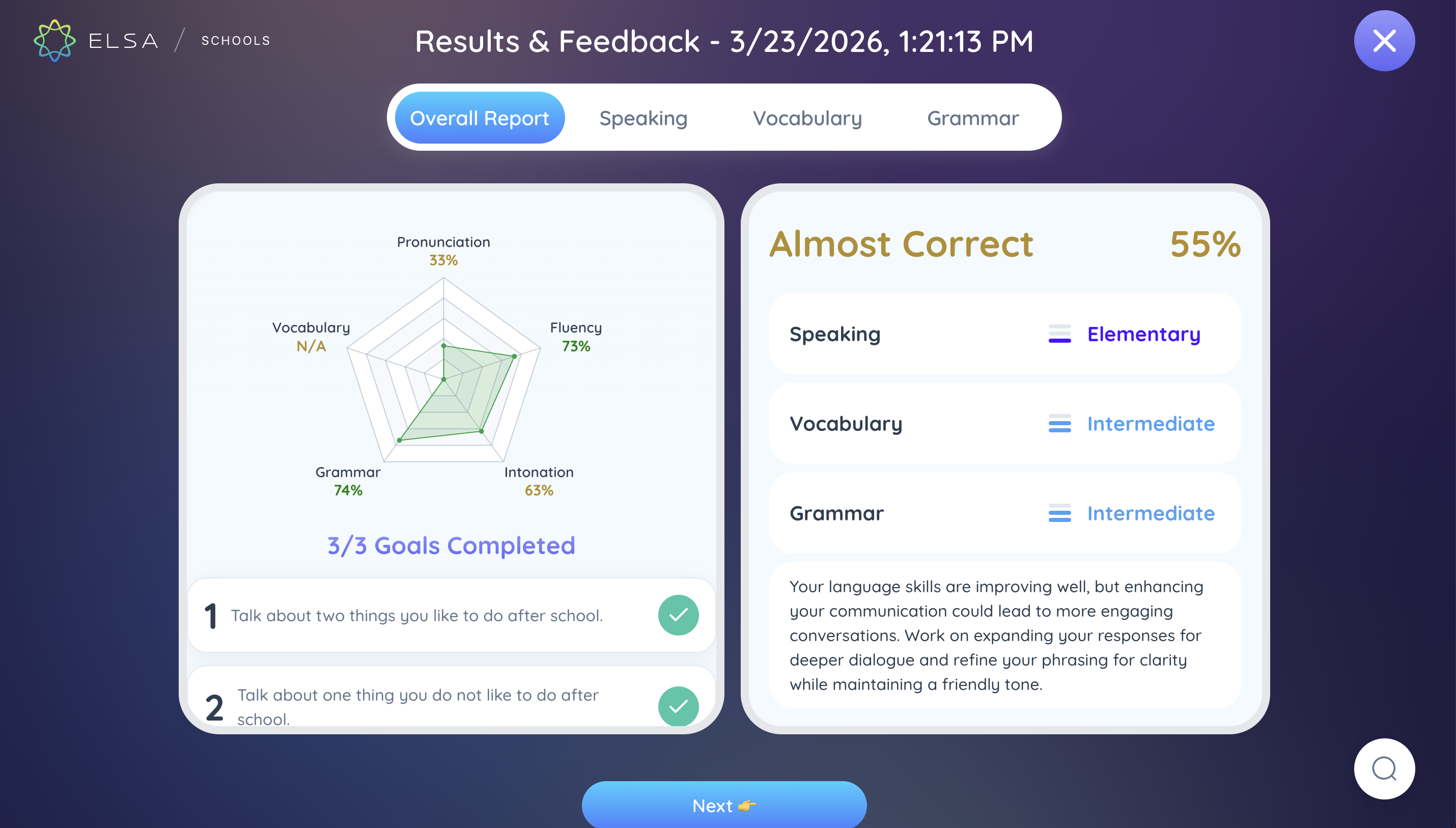
Use this feedback to focus your practice and watch your English speaking skills grow!
Was this article helpful?
That’s Great!
Thank you for your feedback
Sorry! We couldn't be helpful
Thank you for your feedback
Feedback sent
We appreciate your effort and will try to fix the article